Blueberries: A Small Fruit with Deep Intelligence
By Sandy
As we move gently toward late spring, one of nature's most powerful foods begins to appear: the blueberry.
Quiet and unassuming, this small fruit carries a remarkable concentration of compounds that support and protect the body. It is a simple example of how nature organizes itself with precision — developing exactly what is needed to thrive, and in doing so, offering that same support to us.
When is the Right Time to Eat Blueberries?
Blueberry season begins around late April to early May, gradually unfolding through the summer months.
This timing is not fixed. It depends on how the winter has been — its temperature, its rainfall, its rhythm. A milder winter may bring an earlier harvest, while a longer, colder season may delay it.
Another subtle aspect of this season is that it evolves continuously. Different varieties ripen at different times:
- Early varieties mark the beginning of the season
- Mid-season varieties follow
- Late varieties extend the harvest into late summer
This means that the blueberries you eat in May are not the same as those you eat in July — their taste, texture, and nutritional composition naturally shift over time.
The most nourishing moment to eat them is when they are locally grown and fully in season, carrying the imprint of sun, soil, and time.
Why Organic Truly Matters
Blueberries have a delicate, permeable skin, which makes them more vulnerable to absorbing chemical residues. Choosing organic or sourcing from small local producers helps to:
- Reduce exposure to pesticides
- Support healthier soils and ecosystems
- Preserve the integrity of the fruit
When a food already offers such high nutritional value, its purity becomes an essential part of its benefit.
A Nutritional Powerhouse
Blueberries are particularly valued for their anthocyanins — the natural pigments responsible for their deep blue and purple tones.
They also provide:
- Vitamin C and K
- Fiber
- Polyphenols
- Essential minerals
Together, these compounds support:
- Cognitive function and memory
- Cardiovascular health
- Reduction of inflammation
- Gut microbiome balance
Their antioxidant capacity helps the body manage oxidative stress, which plays a role in aging and many chronic conditions.
Not All Blueberries Are the Same
There are hundreds of blueberry varieties worldwide, and several are cultivated in Portugal, including:
- Duke (early season)
- Bluecrop (mid-season)
- Legacy (mid to late season)
- Ozarkblue
- Goldtraube
- Chandler
Each variety differs in size, sweetness, and composition. As the season progresses and varieties change, the nutritional profile of the fruit also changes.
Understanding Nutrient Density and Sweetness
In general:
- Smaller, darker, more intensely flavored berries tend to contain higher levels of antioxidants
- Larger, sweeter, and lighter-colored berries tend to have more natural sugars and a lower concentration of protective compounds
For example:
- Varieties like Goldtraube are often smaller and more concentrated, offering higher antioxidant potential
- Larger varieties like Chandler are juicier and sweeter, but typically less dense in polyphenols
Even within the same variety, soil, climate, and ripeness influence these values.
Wild and Cultivated Blueberries: A Clear Difference
Beyond cultivated varieties, there is also an important distinction between wild blueberries (or berries closer to bilberries) and cultivated ones.
Wild berries tend to be:
- Smaller
- Darker inside and out
- More intense in taste
They often contain:
- Up to 2–3 times more anthocyanins and antioxidants
- Slightly lower natural sugar content
Cultivated blueberries, more commonly found in Portugal:
- Are larger and more uniform
- Often lighter inside
- Tend to be sweeter
They usually contain:
- Moderate antioxidant levels
- Slightly higher natural sugars
- More water content
A Simple Comparison
| Smaller / Wild-Type | Larger Cultivated | |
|---|---|---|
| Antioxidants | Very high (up to 2–3×) | Moderate |
| Anthocyanins | ~300–700 mg | ~100–300 mg |
| Natural sugars | ~7–9 g | ~10–15 g |
| Fiber | Slightly higher | Moderate |
These values are approximate, but they offer a clear orientation: concentration tends to decrease as size and sweetness increase.
What the Inside Color Reveals
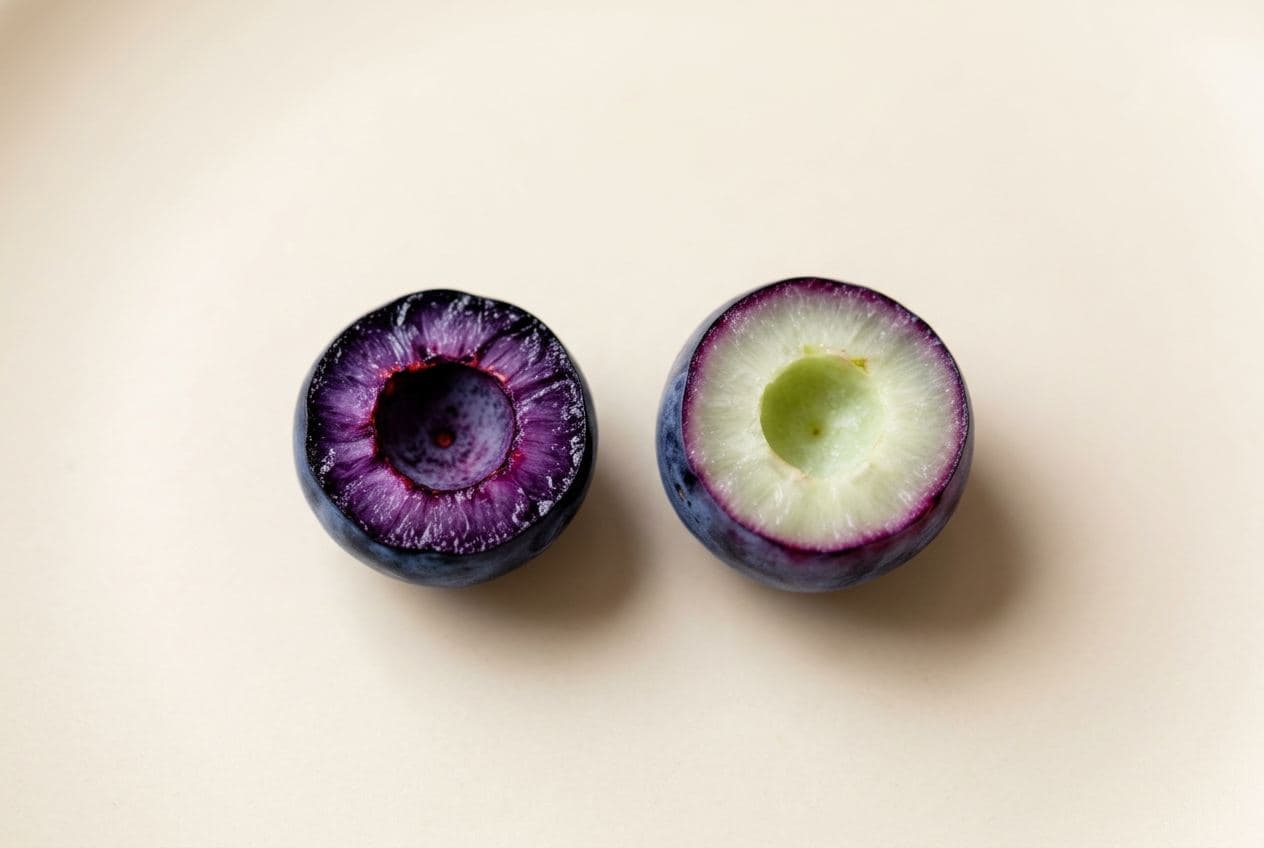
A simple way to understand the quality of a blueberry is to look at its interior.
- A deep purple or reddish flesh indicates a high concentration of anthocyanins
- A pale, greenish or whitish interior suggests a lower concentration of these compounds
In many cultivated berries, the color is concentrated mostly in the skin. In smaller or wild berries, it often extends throughout the fruit.
This visual difference reflects the nutritional density — the fruit quietly showing its composition.
Blueberries & Blood Sugar: A Balanced Perspective
Blueberries are lower in sugar than many fruits, yet they still contain natural sugars that convert into glucose.
For those who are:
- Managing insulin resistance
- Living with diabetes
- Working on weight balance
- Sensitive to blood sugar fluctuations
It can be supportive to:
- Eat them in moderate portions
- Pair them with fats or protein
- Prefer smaller, less sweet, more intensely colored varieties
Their polyphenols may support insulin sensitivity, but balance remains essential.
Ways to Bring Blueberries into Your Daily Life
Blueberries can be used in simple and nourishing ways:
- Fresh with soaked nuts and seeds
- Blended into smoothies or plant-based yogurts
- Added to salads with bitter greens
- Gently cooked into compotes
- Infused into herbal teas
- Combined with fermented foods
They pair especially well with:
- Lemon
- Mint
- Basil
- Raw cacao
- Almond and coconut
A Final Reflection
Blueberries offer more than nutritional value — they offer a living experience of variation and balance.
Across the season, they change in variety, taste, and composition, inviting us to notice, adapt, and choose with awareness.
In their small form, they carry:
- Protection
- Regeneration
- Precision
When eaten in season, sourced with care, and understood beyond their surface, they become not just food — but a quiet, consistent support for the body.
Stay Inspired
Receive seasonal inspiration, recipes, and mindful living tips from Swara Slow Living.